
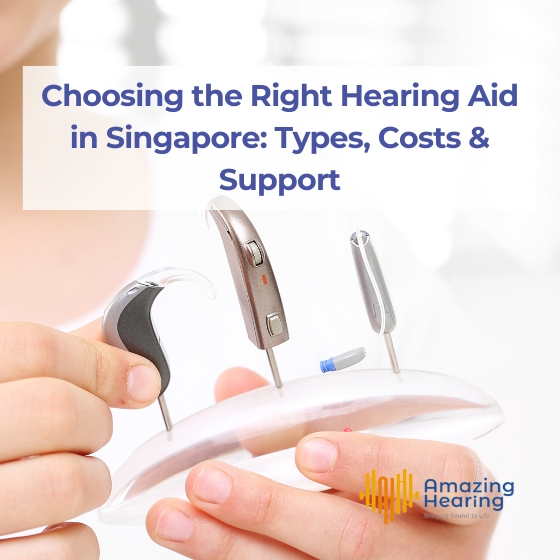
Hearing aids can make a remarkable difference for those with hearing loss, helping people reconnect with conversations, sounds, and daily activities. In Singapore, these devices come in a wide variety of styles and price ranges, from SGD 1,600 to over SGD 9,000 per ear.
With so many choices available, it can feel overwhelming to know which option is right for you. This guide explains the different hearing aid types, what influences their cost, available subsidy schemes, and practical tips for choosing the right one.
Types of Hearing Aids in Singapore
Different hearing aid designs cater to different needs. Here’s a breakdown of the most common styles:
a) Behind-the-Ear (BTE)
BTE models rest behind the ear, with sound delivered through a small tube into the ear canal.
- Pros: Durable, easy to handle, suitable for all ages.
- Best for: Mild to profound hearing loss.
b) Receiver-in-Canal (RIC or RIE)
RIC models place the receiver inside the ear canal, connected by a thin wire.
- Pros: Natural sound, discreet design, versatile.
- Best for: Mild to severe hearing loss.
c) In-the-Ear (ITE)
ITE hearing aids are custom-made to fit the outer ear.
- Pros: Larger size allows extra features, easier to adjust.
- Best for: Moderate to severe loss.
d) In-the-Canal (ITC) & Completely-in-Canal (CIC)
These sit partly or completely inside the ear canal.
- Pros: Small and discreet, less visible than ITE.
- Cons: Limited features, harder to clean and adjust.
- Best for: Mild to moderate hearing loss.
e) Invisible-in-Canal (IIC)
The most discreet option, designed to sit deep in the canal.
- Pros: Nearly invisible.
- Cons: Limited battery life and features.
- Best for: Users who prioritise aesthetics with mild to moderate loss.
Cost of Hearing Aids in Singapore
Prices can vary widely depending on the style and technology level of the device.
Typical Cost Range
|
Category |
Per Ear (SGD) |
Per Pair (SGD) |
|---|---|---|
|
Essential |
1,620 – 3,150 |
3,240 – 6,300 |
|
Standard |
3,500 – 4,000 |
7,000 – 8,000 |
|
Advanced |
4,000 – 5,400 |
8,000 – 10,800 |
|
Premium |
6,000 – 9,152 |
12,000 – 18,304 |
What Explains the Price Difference?
- Essential models: Provide basic amplification for everyday use.
- Standard models: Add more comfort features and slightly better sound processing.
- Advanced models: Include technologies like improved noise reduction and directional microphones.
- Premium models: Offer the latest features such as AI-driven noise management, Bluetooth streaming, rechargeability, and smartphone integration.
Factors That Influence Price
Several factors affect how much a hearing aid costs in Singapore.
a) Technology & Features
Advanced features add to the price but improve usability:
- Rechargeable batteries instead of disposables.
- Bluetooth connectivity for calls and music.
- Automatic noise filtering in crowded areas.
- Water- and sweat-resistant designs for active users.
b) Brand & Research Investment
Leading brands often cost more because they invest heavily in research, testing, and reliability to ensure their products meet high standards.
This includes rigorous quality control, consumer testing, and continuous innovation to deliver durable, trustworthy, and effective solutions that justify the higher price.
c) Customisation & Fit
Custom earmoulds or shells provide a tailored fit that enhances comfort and audio performance, making them ideal for long-term wear or professional use.
However, this level of customisation comes at an additional cost, which may be a consideration for some users.
d) Service Packages
Many providers include:
- Initial fittings and fine-tuning.
- Follow-up consultations.
- Extended warranties and servicing.
While this raises the upfront price, it also ensures better long-term results.
Financial Assistance in Singapore
Hearing aids can be expensive, but subsidies help ease the cost burden.
Seniors’ Mobility & Enabling Fund (SMF)
- Available to eligible seniors.
- Subsidises up to 90% of hearing aid cost, depending on income.
Assistive Technology Fund (ATF)
- For Singaporeans with disabilities, regardless of age.
- Covers up to 90% of device cost (income-tested).
Note: MediSave cannot be used for hearing aid purchases.
Tips for Choosing the Right Hearing Aid
When deciding, think about both your hearing needs and your lifestyle.
Assess Your Hearing Loss
For severe hearing loss, BTE models are often recommended. For mild to moderate hearing loss, RIC or canal models may be sufficient.
Consider Lifestyle Needs
For an active lifestyle, consider water-resistant or rechargeable models.
If you often find yourself in noisy environments, opt for options with advanced noise-cancelling technology.
Aesthetics vs Usability
Smaller devices, such as ITC and IIC, are discreet but may come with fewer features.
On the other hand, larger devices like BTE and ITE are easier to handle and provide more options.
Think About Long-Term Value
Premium devices may cost more initially but often last longer, with features that save on recurring costs like batteries.
Frequently Asked Questions
<
1) How long do hearing aids last?
Typically, 3 to 7 years, depending on usage, maintenance, and environmental factors such as exposure to wear and tear or extreme conditions. Proper care can help extend its lifespan.
2) What ongoing costs should I expect?
- Disposable or rechargeable batteries.
- Servicing and cleaning.
- Occasional software updates.
3) Can hearing aids connect to smartphones?
Yes, many models support Bluetooth streaming, letting you connect wirelessly for calls, music, and TV audio. You can enjoy high-quality sound without the hassle of cords, whether you’re on a call, playing a playlist, or watching TV.
4) Do budget-friendly models work as well?
Entry-level models work well in quiet environments but may struggle in noisy places. Premium models handle complex soundscapes better.
Takeaway
Hearing aids are more than just devices—they are an investment in better communication, independence, and overall well-being. From powerful BTE designs to discreet IIC models, there is a wide spectrum of choices to match different needs and budgets.
By understanding the types, costs, influencing factors, and available subsidies, you can make a confident, informed decision. The best first step is to book a hearing assessment, which helps match your hearing profile with the most suitable technology.
