
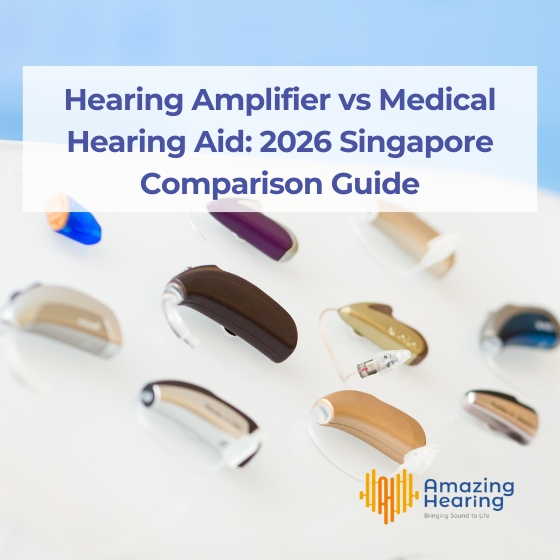
Short answer: A hearing amplifier makes every sound louder. A medical hearing aid is programmed to your audiogram so it boosts only the frequencies you are missing, keeps loud sounds at a safe level and separates speech from background noise.
In Singapore, medical hearing aids are HSA-registered Class B medical devices and qualify for government subsidies of up to 90% under the SMF and ATF. Amplifiers are unregulated, get no subsidy and can damage your hearing further.
Key Takeaways
- Amplifiers add volume. Medical hearing aids add clarity through digital signal processing.
- Medical hearing aids are regulated by the Health Sciences Authority (HSA) as Class B medical devices. Amplifiers are not.
- A professional hearing test is the only way to know your type and degree of hearing loss before buying anything.
- From January 2026, the SMF and ATF income cap rose to $4,800 per capita household income, so more families qualify for subsidies of up to 90% on medical hearing aids.
- No subsidy exists for hearing amplifiers.
Hearing Amplifier vs Medical Hearing Aid: What Is The Difference?
An amplifier is a recreational gadget for people with normal hearing. A medical hearing aid is a regulated instrument prescribed to treat hearing loss. They can look similar on a shelf, but the technology inside does completely different jobs.
|
Hearing amplifier (PSAP) |
Medical hearing aid |
|
|---|---|---|
|
Who it is for |
People with normal hearing who want to hear faint sounds (birdwatching, lectures) |
People with diagnosed hearing loss |
|
How it processes sound |
Linear amplification: every sound boosted by the same amount |
Non-linear compression: more boost for soft sounds, less for loud |
|
Frequency targeting |
None. Boosts all pitches equally |
Frequency-specific gain matched to your audiogram |
|
Background noise |
Boosted along with speech |
Filtered by digital signal processing and directional microphones |
|
Output limiting |
Usually none. Can reach damaging volumes |
Capped at safe levels for your comfort range |
|
Regulation in Singapore |
Not a medical device |
HSA Class B medical device |
|
Fitting |
None. Put it in and go |
Programmed and verified by an audiologist using Real Ear Measurement |
|
Typical lifespan |
Months |
Five to seven years with servicing |
|
Warranty and local repair |
Rarely |
Manufacturer warranty and local clinic support |
|
Government subsidy |
None |
SMF and ATF, up to 90% |
What Is A Hearing Amplifier (PSAP)?
A Personal Sound Amplification Product is a sound booster for people with healthy hearing. Think binoculars for your ears: it helps you pick up a bird call on a nature walk or a lecturer from the back of a hall.
- Sold over the counter or online with no hearing assessment
- Cannot tell speech from noise, so everything gets louder together
- Frustrating in Singapore’s noisy hawker centres and busy streets
What Makes A Medical Hearing Aid Different?
A medical hearing aid is programmed to your diagnostic audiogram, then verified by an audiologist. Your audiogram maps exactly which frequencies you are missing. The device is set to give the precise amplification your loss needs, so soft speech becomes clear while loud sounds stay safe.
In Singapore, HSA classifies hearing aids as Class B medical devices, which means they must meet safety and performance standards that generic amplifiers do not.
Why Does A Medical Hearing Aid Sound Clearer, Not Just Louder?
Because it uses digital signal processing (DSP) to separate speech from noise, and non-linear compression to keep sound inside your comfort zone. The most common complaint from amplifier users is “I can hear people talking but I can’t understand the words.” This is why.
What Is The Problem With Amplifiers In Noisy Places?
Amplifiers raise the noise floor. The hum of an air conditioner or the roar of traffic is boosted just as much as your loved one’s voice, so speech gets harder to pick out.
Medical hearing aids analyse incoming sound thousands of times per second to separate speech from noise. For sensorineural hearing loss, the device applies frequency-specific gain: it boosts only the high or low pitches you struggle with and leaves the rest untouched.
Linear Amplification vs Non-Linear Compression
|
Linear (amplifiers) |
Non-linear compression (medical aids) |
|
|---|---|---|
|
How it works |
Every sound increased by the same fixed amount |
Soft sounds boosted more, loud sounds boosted less |
|
Effect on loud sounds |
Become painfully loud very quickly |
Stay within your comfort range |
|
Dynamic range |
Ignored |
Respected: the window between your softest audible sound and your discomfort threshold |
Which Features Do Only Medical Hearing Aids Have?
- Directional microphones. Focus on the person in front of you at a busy Tiong Bahru hawker centre and suppress the clatter behind you.
- Feedback cancellation. Stops the high-pitched whistling cheap amplifiers make when you hug someone or adjust your hair.
- AI-driven noise reduction. Learns your environment and dampens steady hums like fans or engines.
- Clinical customisation. An audiologist programs all of the above to your hearing profile and lifestyle.
Are Hearing Amplifiers Regulated In Singapore?
No. Medical hearing aids are HSA-registered Class B medical devices. Amplifiers sold on global marketplaces often bypass local regulation entirely.
The biggest safety gap is output limiting. Unregulated amplifiers frequently have no cap on volume, so a car horn can be amplified straight into your ear canal at a level that causes acoustic trauma or permanent inner-ear damage.
Amazing Hearing Centre only supplies HSA-approved devices that have passed clinical testing for safety and performance.
What Are The Risks Of Buying An Amplifier Online?
Buying online assumes you already know why you can’t hear. Often you don’t.
- What feels like permanent hearing loss may be ear wax impaction or a middle ear infection, both of which need treatment, not volume.
- Using a cheap amplifier delays a professional check-up and lets a progressive condition worsen.
- When a poor device fails to deliver clarity, many seniors conclude their hearing is beyond help and withdraw from social life. The real problem was the wrong tool.
What Should I Look For In HSA Class B Certification?
Every legitimate medical hearing aid in Singapore is registered with HSA as a Class B medical device. This confirms it is safe for long-term use and effective for treating hearing loss.
At our clinics in Novena, Chinatown, Jurong and Tampines, you will find only HSA-registered brands such as GN ReSound, with manufacturer warranties and local support. Your hearing changes over time, so having a local team means fast recalibration and repairs rather than mailing a device overseas and waiting weeks.
How Do I Choose Between A Hearing Amplifier And A Medical Hearing Aid?
Follow three steps: get a clinical diagnosis, match the device to your lifestyle, then compare cost per year rather than sticker price. You wouldn’t buy prescription glasses without an eye exam. Your ears deserve the same.
Step 1: Get A Hearing Test
A professional assessment is the only way to tell mild from moderate hearing loss. To you they can feel similar, but a mild loss may only need help in specific quiet settings, while a moderate loss means your brain is actively losing the ability to decode speech. Your audiogram is the blueprint for treatment. Without it, you are guessing.
Step 2: Match The Device To Your Lifestyle
|
Your lifestyle |
What you need |
|---|---|
|
Mostly at home, quiet environment |
A basic solution may be enough |
|
Family dinners, active social life, volunteering |
Medical device with noise filtering |
Step 3: Compare Cost Per Year
A medical hearing aid costs more upfront but typically lasts five to seven years and includes professional support. A disposable amplifier may need replacing every few months. Break it down per year and the medical aid is usually the more sustainable spend.
Signs You Need A Medical Hearing Aid
- You struggle to follow conversations when more than one person is talking or there is background noise
- Family members complain the TV is uncomfortably loud
- People seem to mumble, and you keep asking them to repeat themselves
Why Does Clinical Verification Matter?
Every ear canal has its own shape and resonance, which changes how you perceive sound. Amazing Hearing Centre uses Real Ear Measurement (REM): a tiny probe microphone in your ear canal measures exactly how sound is delivered, and the audiologist fine-tunes the output so speech is clear without being uncomfortably loud. An amplifier cannot do this.
Where Can I Get A Medical Hearing Aid In Singapore?
Amazing Hearing Centre has four clinics in Novena, Chinatown, Jurong and Tampines, staffed by qualified audiologists who handle diagnosis, fitting and long-term aftercare.
We supply HSA-approved devices from brands like GN ReSound, programmed to the frequency gaps identified in your assessment.
What Government Subsidies Are Available For Hearing Aids In 2026?
Eligible Singaporeans can get means-tested subsidies of up to 90% on medical hearing aids through the Seniors’ Mobility and Enabling Fund (SMF) or the Assistive Technology Fund (ATF).
|
SMF |
ATF |
|
|---|---|---|
|
Who |
Seniors aged 60 and above |
Persons with disabilities (including moderate hearing loss or worse) |
|
Income cap (from Jan 2026) |
$4,800 monthly per capita household income |
$4,800 monthly per capita household income |
|
Subsidy |
Up to 90% |
Up to 90%, lifetime cap of $40,000 |
|
Covers amplifiers? |
No |
No |
- The income cap was raised from $2,600 to $4,800 in January 2026, so more families now qualify.
- MediSave cannot be used for hearing aids. These subsidies are what bridge the gap.
- Our team helps Pioneer and Merdeka Generation seniors check eligibility and complete the SMF and ATF paperwork.
What Aftercare Do You Provide?
The fitting matters as much as the device, and our support continues after you leave. We provide:
- Personalised programming for your ear canal resonance
- Regular cleaning and performance checks
- Recalibration as your hearing changes
Ready To Find Out Which Is Right For You?
Amplifiers give you volume. HSA-approved medical hearing aids give you clarity, safety and a device tuned to your diagnostic profile. If louder hasn’t meant clearer, the next step is a hearing test.
Book a comprehensive hearing assessment at any of our four Singapore locations. We’ll also walk you through the 2026 SMF and ATF subsidies so cost doesn’t stand between you and clear conversation.
Frequently Asked Questions
Can A Cheap Hearing Amplifier Damage My Hearing Further?
Yes. Unregulated amplifiers often lack output limiting, so a sudden loud noise can be boosted to a level that causes immediate acoustic trauma and permanent inner-ear damage.
Medical hearing aids are calibrated so even the loudest sounds stay within safe thresholds.
Do I Need A Doctor’s Referral To Get A Medical Hearing Aid In Singapore?
No referral is needed to visit a private audiology clinic for a test or purchase.
To apply for SMF or ATF subsidies, you will typically need a formal assessment from a restructured hospital or registered healthcare professional. Our Novena and Jurong clinics can run a diagnostic test on the spot.
Why Are Medical Hearing Aids So Much More Expensive Than Amplifiers?
You are paying for digital signal processing that separates speech from noise, clinical customisation to your audiogram, Real Ear Measurement verification, and years of audiologist aftercare. An amplifier is a basic speaker that boosts everything equally.
Can I Use An Amplifier If I Have Tinnitus?
Not recommended. An amplifier can worsen your perception of the ringing. Tinnitus usually comes with frequency-specific hearing loss that needs a targeted approach.
Many medical hearing aids include built-in sound therapy or masking features, but a professional tinnitus assessment should come first to identify the cause.
How Long Do Medical Hearing Aids Last Compared To PSAPs?
Medical hearing aids typically last five to seven years with dehumidifier storage and regular servicing, backed by manufacturer warranties and local repairs.
PSAPs use lower-quality components and are not built for long-term daily use.
Are There Government Subsidies For Hearing Amplifiers In Singapore?
No. SMF and ATF subsidies apply only to HSA-approved medical devices prescribed by qualified professionals. We can check your eligibility for subsidies of up to 90% on a medical hearing aid.
How Is Fitting A Hearing Aid Different From Using An Amplifier?
An amplifier is one size fits all: you put it in your ear with no adjustment. A medical hearing aid is fitted by an audiologist using Real Ear Measurement, which places a probe microphone in your ear canal to match the device output to your audiogram and your ear’s unique shape.
Is It Legal To Sell Medical Hearing Aids Online In Singapore?
HSA regulates hearing aids as Class B medical devices, and they should not be sold through online-only platforms without professional clinical involvement.
Some over-the-counter options are emerging in 2026, but medical devices still require a physical fitting and verification by a licensed provider. We do not offer online-only sales for this reason.
